
Gateway Services
Secure payment gateway integration for AI apps, bots and conversational IVR.
- Accept payments securely from AI apps, bots, voicebots and conversational IVR journeys
- Keep sensitive card data away from your application using PCI DSS compliant payment services
- Integrate quickly with a developer-friendly API and Hosted Payment Fields
- Route payments intelligently across acquirers to reduce cost and improve acceptance
- Support Open Banking, card payments, tokenisation and recurring payments
- Connect seamlessly with Encoded’s wider payment suite, including IVR, PayByLink, eCommerce and Agent Assisted Payments

What is a payment gateway?
A gateway is the secure connection between your customer-facing payment experience, your chosen acquirer and the banks that authorise the transaction.
That means your app or bot can guide the conversation, confirm the payment amount and trigger the payment journey, while Encoded manages the secure gateway processing needed to authorise the transaction and support settlement.
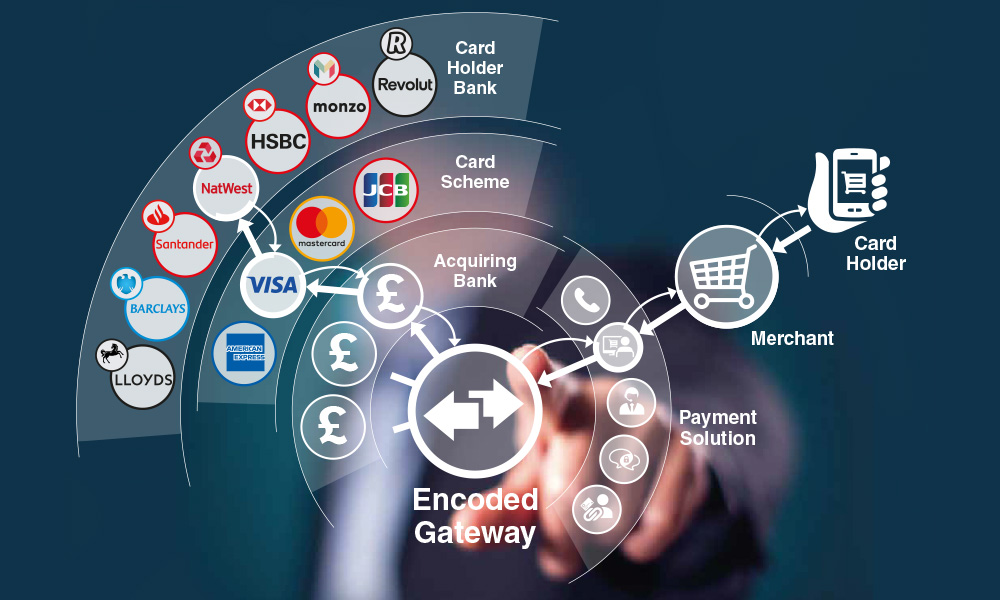
That makes Encoded Gateway Services a strong fit for businesses adopting AI-powered customer engagement. You get the flexibility to build modern conversational experiences, backed by a proven payment platform designed for security, compliance and operational control.
AI systems, bots and conversational platforms should not be exposed to sensitive card data. Encoded helps reduce that risk by providing secure payment services that keep card capture and processing within a compliant payment environment.
Hosted Payment Fields and secure payment flows help reduce PCI DSS scope while giving customers a smooth experience. Encoded Gateway Services also support PSD2 and Strong Customer Authentication requirements, including EMV 3-D Secure functionality out of the box.
Encoded Gateway Services are designed to be straightforward to integrate. Our developer-friendly API, UAT environments and test card data help teams build, test and launch secure payment journeys with confidence.
Hosted Payment Fields let you control the look and feel of the payment experience without taking on unnecessary PCI DSS burden. That is especially useful for AI apps, bots and conversational IVR journeys where the payment step needs to feel like a natural part of the customer interaction.
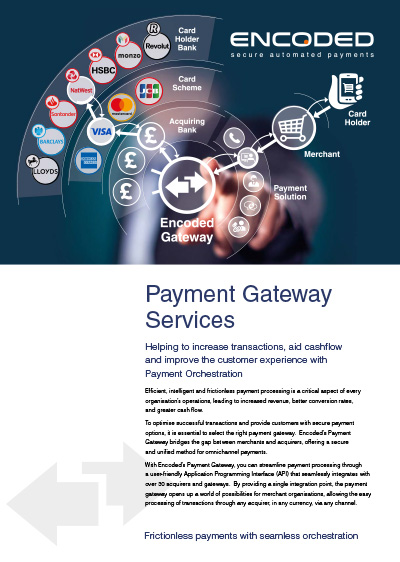
Download our Gateway brochure
AI payment integration
The ideal payment layer for AI assistants, bots and conversational IVR
Take payments inside automated journeys without exposing sensitive card data.
Encoded Gateway Services provide the secure payment layer that AI experiences need. Your application can focus on the conversation, intent recognition and customer experience, while Encoded manages the payment interaction, gateway processing, tokenisation, routing and compliance controls.
Encoded's Gateway offers true Orchestration, a real-time payment decision layer.
Why is this useful? A gateway passes transactions on; orchestration decides where each payment should go.
- One modern API can sit above multiple gateways and acquirers.
- Routing decisions can use cost, card type, stored token, MCC, geography, risk and provider availability.
- Open banking and fraud checks can add evidence for stronger authentication and liability-shift conversations.
- Encoded Insights can support mid-contract acquiring negotiations and least-cost routing.
Payment channels
Encoded Orchestration Layer
Real-time rules select the gateway, acquirer and security checks that fit the transaction.
Payment destinations
Payment comes in, Encoded applies rules, and the transaction takes the best route.
AI customer service assistants that collect outstanding balances
Chatbots that guide customers through secure payment journeys
Voicebots and conversational IVR that allow callers to pay without agent involvement
In-app payment flows for customer portals and mobile apps
Automated collections, renewals, subscriptions and top-ups
Hybrid journeys that move between bot, agent, IVR, web and PayByLink
What are the Key Features of a Payment Gateway?
Secure payment gateway integration for AI apps, bots, voicebots and conversational IVR
A single, simple API for multiple payment channels
Hosted Payment Fields for branded, PCI DSS compliant payment capture
Dynamic acquirer selection for least-cost routing
Integration with multiple acquirers and payment providers
Support for eCommerce, in-app, MOTO, IVR and Open Banking payments
EMV 3-D Secure functionality out of the box
Secure token vault for repeat and recurring payments
A centralised portal for management, reporting and fraud protection
- Dynamic acquirer selection for least-cost routing and acquiring to save money
- Hosted Payment Fields save time and confusion as developers retain control of the look & feel of e-commerce pages
- Reduces and eliminates PCI DSS scope to improve security and reduce the cost of compliance
- Faster settlement and reduced transaction costs through a single provider for improved cashflow
- Seamless integration with Encoded’s entire suite of payment solutions for reduced cost and improved customer experience (CX)
Frequently Asked Questions

Payment solutions for contact centres
Our suite of payment solutions for contact centres include Gateway Services, IVR, Agent Assisted Payments with Fraud Prevention Platform, eCommerce Payments and SMS PayByLink.

IVR Payments
Interactive Voice Response Payments (IVR Payments) is a method that allows callers to enter their card data via touch tones. This self-service process enables debit and credit card payments to be handled 24/7.

PayByLink
Designed for large corporates, Encoded’s PayByLink service offers a fast, hassle-free method of sending a one-time-use short code link to a customer’s phone or email address which can then be used to open a simple payment form.

Agent Assisted Payments

eCommerce Payments

Gateway Services

Download our guides
Secure Contact Centre Payments brochure
What our customers say about us

“We needed to offer our members both fast and secure Payment Card Industry Data, Security Standard (PCI DSS) compliant payment methods and advanced e-commerce capabilities using automated technology. Encoded had done their homework and cared about our members and our business, even suggesting additional creative ways to use Encoded technology. From the outset, it was clear they were exploring new ideas to help us work even smarter.”
Karen Coates, Chief Operations Officer, The Wine Society


“We handle hundreds of thousands of calls every year that demand a broad knowledge of financial and legal matters as well as general property maintenance issues. Encoded presented a sound proposal that promised to deliver round-the-clock efficiencies in a cost effective package. The final overall approach and sophisticated IVR technology proved to be the perfect answer to our business problems.”
Tracey McCabe, Head of Customer Service, First Port Property Management

“We decided to refresh the online experience in response to customer demand and changes in the industry. It was a moment of clarity – Encoded was already handling our secure payments with data being fed into our billing system. We needed to create a front-end link so that customers could access this information themselves, rather than relying on speaking to an agent every time they wanted to make a payment or a change to their account details.”
Business Optimisation Manager,
Severn Trent Water

“One of the key reasons for choosing Encoded was to improve the team’s experience of managing large scale migrations from legacy payment systems. With Encoded’s in-depth knowledge of data security, PCI DSS compliance and the latest payment regulations, JT had confidence that the integration would be carried out within the project timescales and to budget.”
Tim Peach, Finance Operations Manager, Jersey Telecom

“From the outset, it was evident that Encoded grasped our requirements for an easy to deploy, fully transparent solution that could integrate seamlessly with our own IT systems. What is more, Encoded offered us a solid and highly scalable platform that promised to drive efficiencies whilst delivering the personal touch to those callers who needed it most.”
Collections and Recovery Department, One Savings Bank

“Along with the simplicity and highly configurable nature of Encoded’s solution, we were impressed by everyone’s professional, can-do attitude backed up by excellent support. Encoded offered a truly scalable solution that could grow with our business. In particular we trusted Encoded to support new ventures such as flexecash® which has already been adopted by a number of high street retailers.”
June Potts, Head of Customer Contact, Park Group

“Tens of thousands of calls relating to payment and meter reads are handled by sophisticated technology provided by Encoded. Encoded’s solutions have supported our business from day one, having been selected from a shortlist of four vendors for its ease of use, speedy implementation and cost-efficiency.”
Shell Energy

“Today, around 10% of all our sales are made using credit or debit card transactions. Our job is to make it easy for customers to pay for services swiftly and securely. Encoded listened carefully to our requirements, made sensible recommendations along the way and even adapted the technology to suit us. The whole experience ran smoothly and we were impressed by their level of knowledge and understanding of our business.”
Peter Doyle, Risk Manager,
Health-on-line
Articles you may be interested in

Five reasons why every contact centre should have a PCI DSS Compliance Programme in place
With Christmas fast approaching, contact centres are starting to prepare for increased calls and transactions. However, with payment card fraud continuing to rise and data theft constantly in the news, non-PCI DSS compliant contact centres…

Whose responsibility is it anyway?
The Payment Card Industry Data Security Standard (PCI DSS) was originally the brainchild of the world’s five largest payment card providers VISA, MasterCard, American Express, Discover and JCB International. Today, it is a global framework…

Wise up on PCI DSS and Save a Fortune
Every contact centre that accepts credit and debit card payments over the telephone needs to be PCI DSS (Payment Card Industry Data Security Standard) compliant. However the process of becoming and staying compliant can be hugely expensive…
Speak to the team
To discover how our secure payment solutions can free up your contact centre agents' time allowing them to focus on customer service, more complex enquiries and revenue-generating activities.